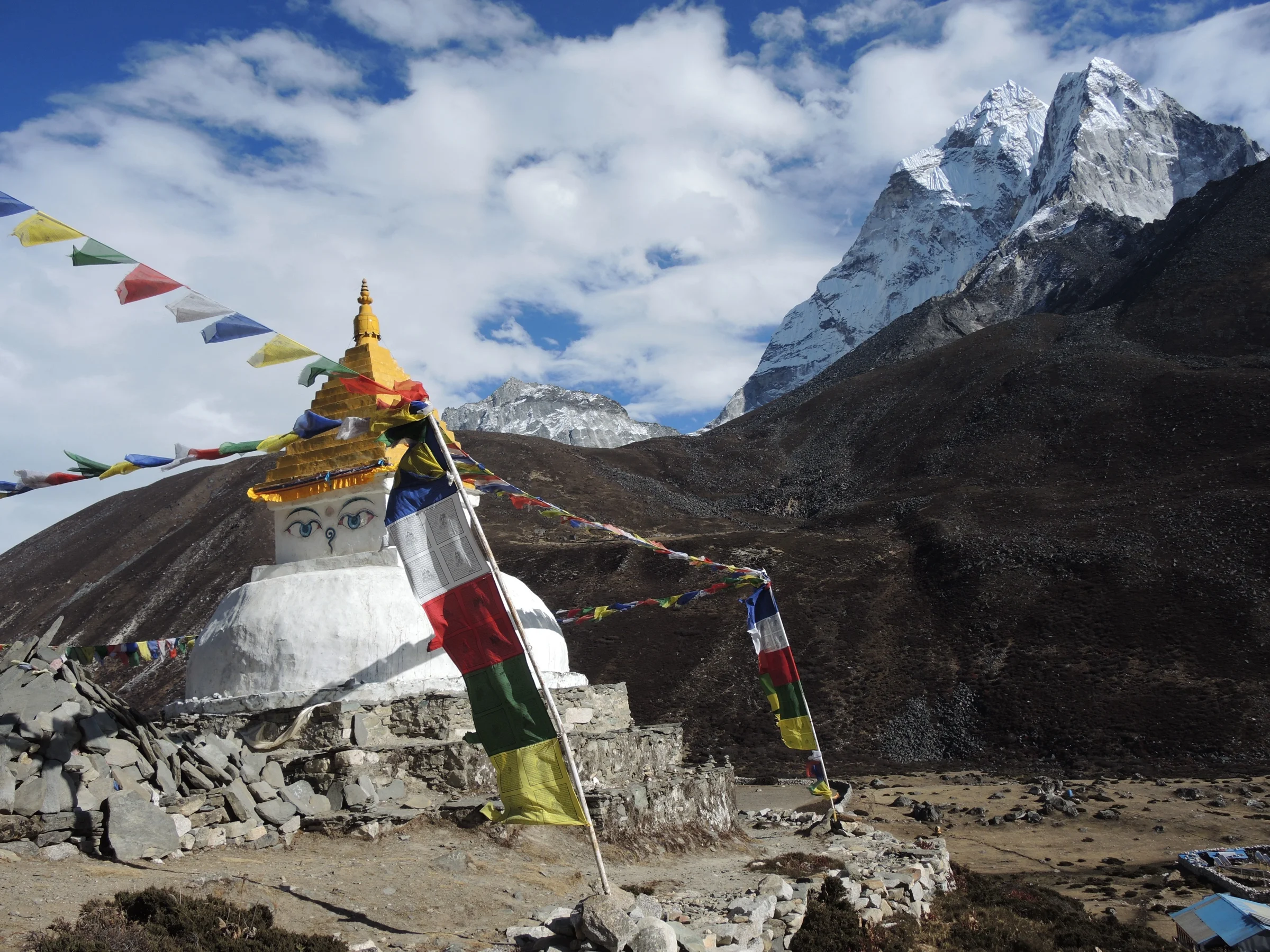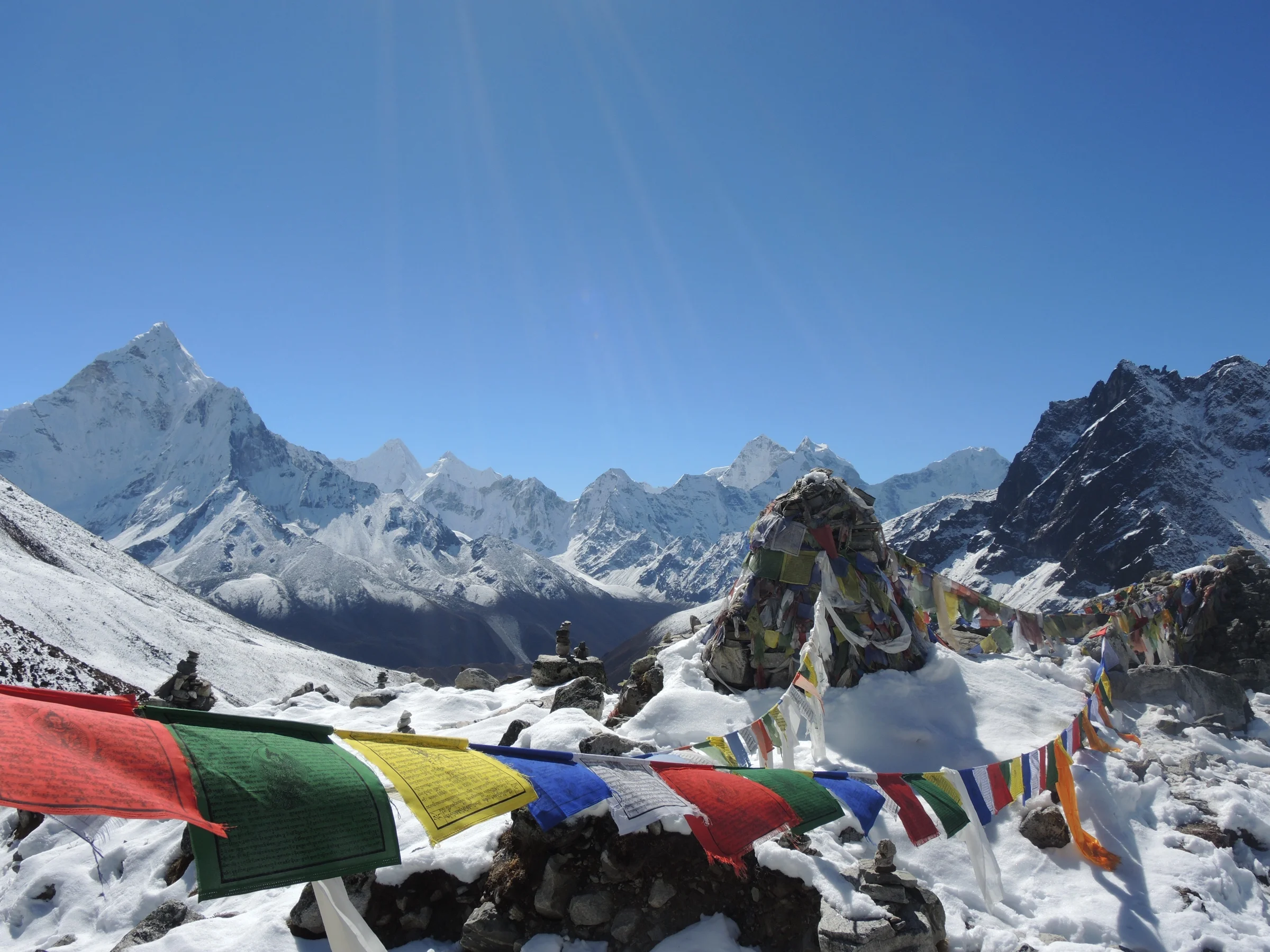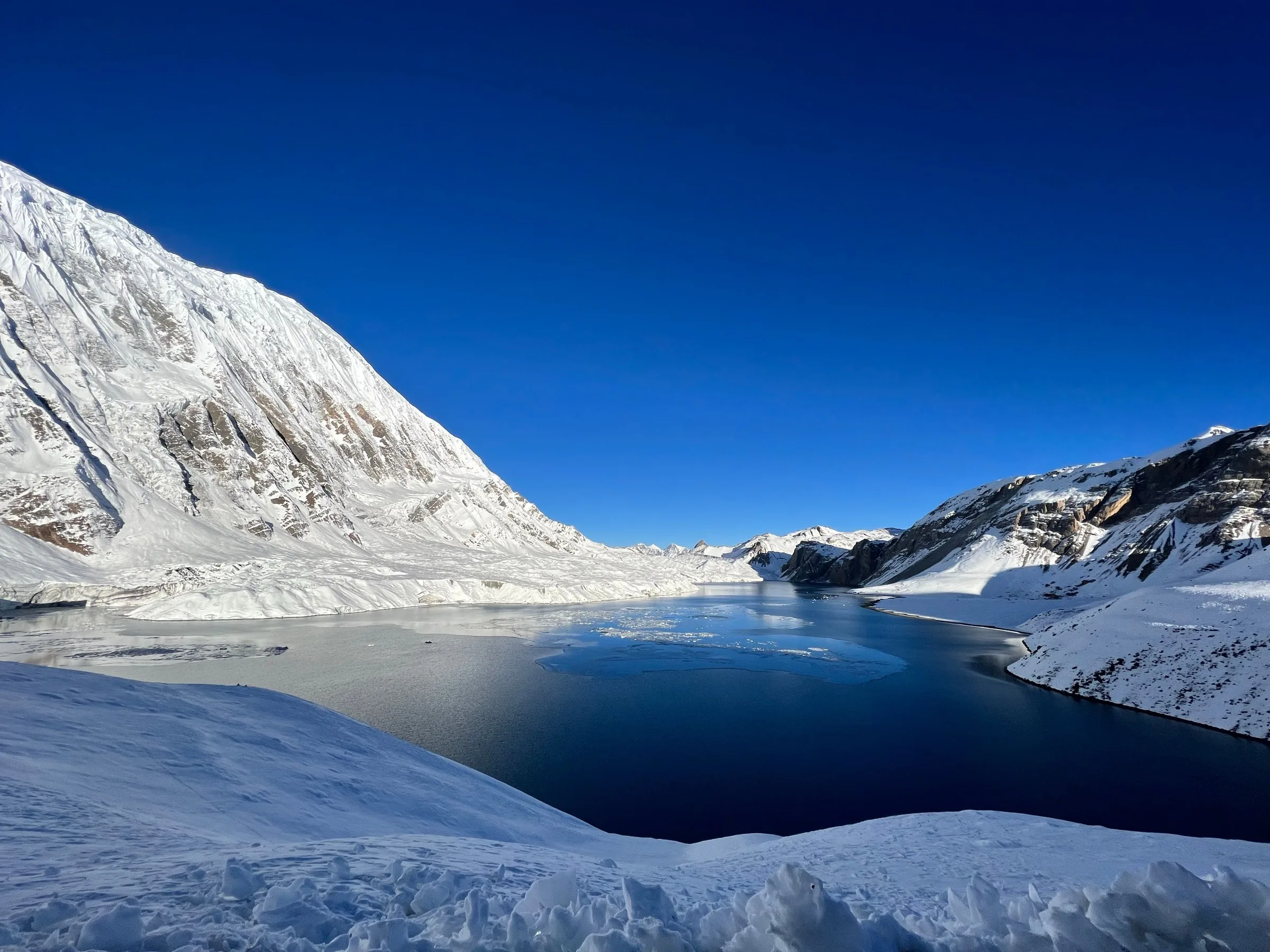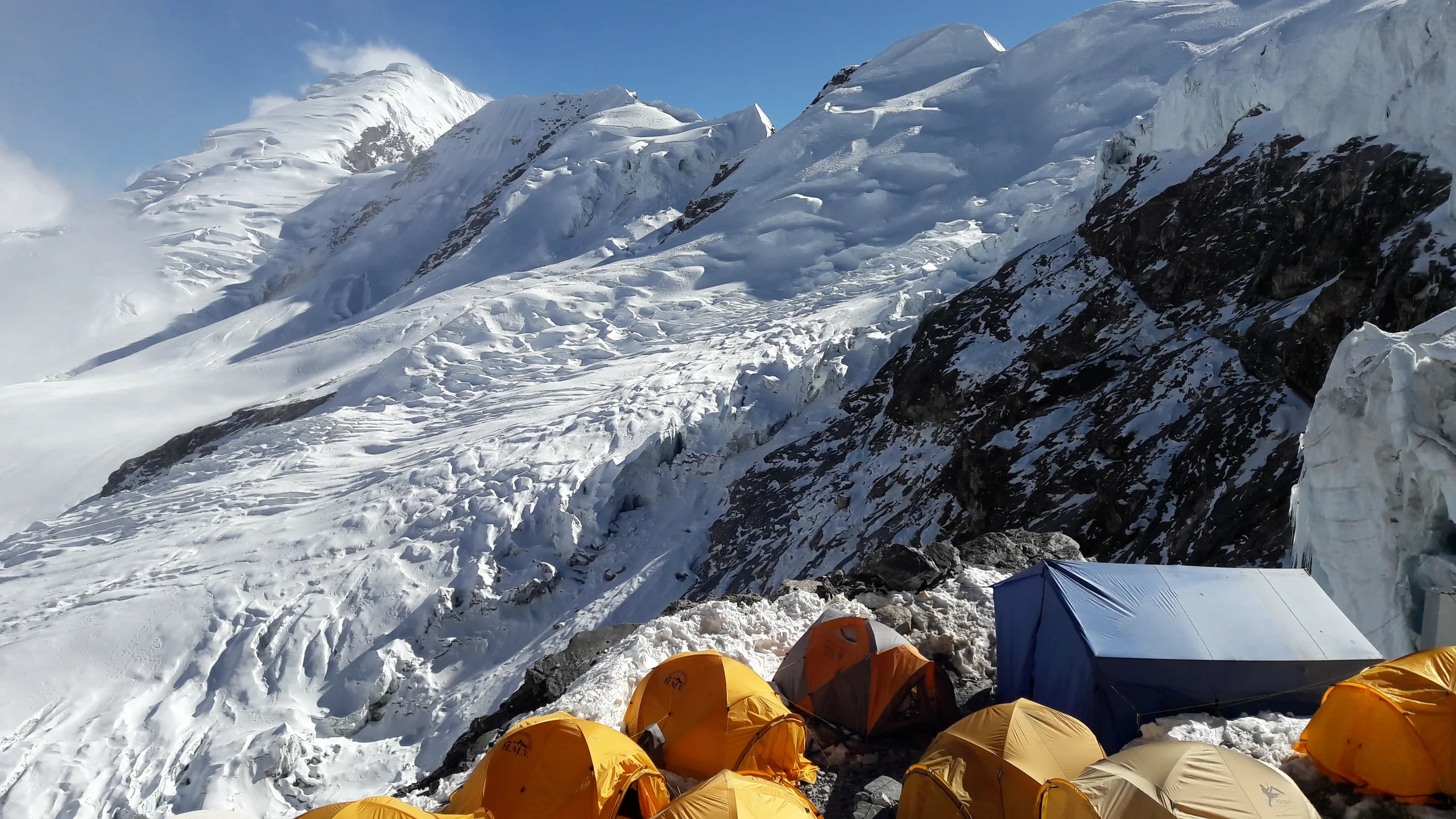
In the heart of the Khumbu and Makalu regions, the ascent of Mera Peak (6,476 m) leads to one of the most accessible peaks above 6,000 m in Nepal. The route follows the remote Hinku valley, away from the busy Everest trails, and crosses a mosaic of rhododendron and pine forests, moraines and glaciers, where the wildlife and vegetation of Makalu Barun National Park sit alongside Sherpa villages rooted in their traditions.
After the formalities and equipment preparation in Kathmandu, the trip begins with a scenic flight to Lukla, the gateway to the trek. From Lukla, the trail heads down towards Paiya through a small jungle and waterfalls, before crossing the Kari La pass (3,145 m) towards Panggom. The route continues to Ningsow and then the Chhetra Khola, where Mera Peak appears for the first time above the forests. This section of the trek, little frequented, passes through isolated hamlets where the remoteness is felt as much as the landscape impresses.
From the Chhetra Khola, the climb continues via Kothe, Thangnak and Khare to the Mera high camp, at 5,780 m. The ascent is gradual: each stage gains little altitude, and a rest day at Khare allows the body to adapt before the final effort. There, climbers also receive an introduction to ice-climbing techniques and to handling the equipment — crampons, ice axe, ropes — needed for summit day.
The final climb begins in the middle of the night, to make progress on the Mera Glacier before the snow warms up. The route, essentially a long walk on the glacier, presents no extreme technical difficulty, but the altitude and the cold make it a demanding challenge. At the summit, the panorama extends over Everest (8,848 m), Cho Oyu (8,188 m), Lhotse (8,516 m), Makalu (8,485 m), Kangchenjunga (8,586 m), Nuptse (7,861 m), Chamlang (7,319 m) and Baruntse (7,129 m).
The descent takes the same route to Kothe, then goes by Thuli Kharka before crossing the Zatrwa La pass (4,610 m) to reach Lukla.
Spring (March to May) and autumn (September to November) are the best seasons for this climb, with stable weather and clear views of the surrounding peaks. Winter remains feasible for experienced climbers, ready to face the cold and the snowfall; the monsoon, on the other hand, makes the trails slippery and limits visibility, and is not recommended.
Highlights
The flight to Lukla
Fly over the Himalayan foothills on the short scenic flight to Lukla, the gateway to the Khumbu valley.
The remote Hinku valley
Make your way along the Hinku Khola River, through rhododendron and oak forests, to the isolated hamlets of Kothe, Thangnak and Khare.
Lungsumgba Monastery
Discover this two-century-old gompa, where a rock bears the outline of the Mera Peak route.
The summit of Mera Peak
At the end of a night-time climb on the Mera Glacier, enjoy, at 6,476 m, from one of the most accessible peaks above 6,000 m in Nepal, a panorama over Everest (8,848 m), Lhotse, Makalu and Kangchenjunga.
The Zatrwa La pass
Cross this high pass (4,610 m) on the way back, with views of Cho Oyu, Kongde and Numbur Himal, before descending to Lukla.
Wildlife and flora of Makalu Barun National Park
Cross the rhododendron and pine forests of this protected park, a refuge of unspoilt Himalayan biodiversity, and meet the Sherpa communities of the villages you pass through.
Itinerary
On arrival at Tribhuvan International Airport, a representative of our local partner welcomes you and drives you to your hotel in Kathmandu. The rest of the day is free: rest after the flight or a first look at the Nepalese capital, and a welcome dinner is offered in the evening. Night in Kathmandu (1,400 m).
A day is devoted to preparations for the climb. After gathering the documents needed for the climbing permit, you sort through the full climbing equipment — crampons, ice axe, ropes — with the help of an instructor who explains how to use it. It is also a chance to meet the trek guide and the other members of the rope team before departure. Night in Kathmandu (1,400 m).
The flight to Lukla leaves from either Kathmandu or Ramechhap, depending on availability, which is known at booking. From Ramechhap, allow 4 to 5 hours by road followed by a 15-minute flight; if a flight is available from Kathmandu, it is a direct flight of about thirty minutes. This flight over the Himalayan foothills marks the real start of the trek. From the Lukla runway, the trail reaches Paiya, crossing a small jungle to the suspension bridge over the Handi Khola River, then continuing to the village. Night in Paiya (2,730 m).
The trail leaves Paiya by a marked descent to the Paiya Khola River, then climbs back up to the Kari La pass (3,145 m). Beyond the pass, the trail passes through bamboo and rhododendron forests, follows the Tham Danda, then goes via Jaubari and Bhalukhop to reach Panggom. Night in Panggom (2,846 m).
From Panggom, the trail climbs to the Panggom pass (3,174 m) before descending to the Tho Kharka pasture. The descent continues towards the Peseng Kharka Khola River, dotted with waterfalls, then crosses the Ningsow Khola River to reach the village of Ningsow. Night in Ningsow (2,863 m).
The climb to the Ramailo Danda reveals the first views of Mera Peak (6,476 m) and the Salpa ranges. The Pasang Lhamu trail then leads to the Chhetra Khola, through Makalu Barun National Park, where wildlife can sometimes be glimpsed between the trees. Night in Chhetra Khola (3,122 m).
The main trail towards Mera Peak first follows the Majang Khola River, then joins the track that follows the Hinku Khola River through a rhododendron forest. After Tashing Ongma, a bridge over the Sanu Khola River leads to Kothe, at the entrance to the upper valley. Night in Kothe (3,580 m).
Today's trail follows the Hinku Khola River, through a dense forest of rhododendron and oak. The trail passes the two-century-old Lungsumgba Monastery, where a rock bears the outline of the Mera Peak route, before reaching Thangnak. Night in Thangnak (4,358 m).
During this short stage, the trail to Khare follows the north face of Mera Peak and then the Dig Glacier to Dig Kharka, with views of Charpate Himal. Khare, the last village before the mountain, marks the threshold of the glacial part of the climb. Night in Khare (5,045 m).
A day of rest and acclimatisation is essential before going higher: above 3,000 m, the body needs time to adapt, and the ascent of Mera Peak reaches 6,476 m. The day is also used for a training session in ice-climbing techniques and equipment handling. Night in Khare (5,045 m).
The stony trail climbs to the Mera La pass (5,415 m), then drops slightly towards base camp before a gradual climb to the Mera high camp. In clear weather, Everest (8,848 m), Makalu (8,485 m), Cho Oyu (8,188 m) and Lhotse (8,516 m) stand out on the horizon. Night in Mera high camp (5,780 m).
The start takes place early, around 3 a.m., to begin the steep climb along the Mera Glacier. On this snow-covered terrain, climbing equipment is essential, though the technique required is not extreme: the climb is done roped together, and the last metres are climbed on a fixed rope. At the summit (6,476 m), the panorama opens onto Everest (8,848 m), Cho Oyu (8,188 m), Lhotse (8,516 m), Makalu (8,485 m), Kangchenjunga (8,586 m), Nuptse (7,861 m) and many other Himalayan giants. After a few moments at the summit, you descend to the high camp and then to Khare. Night in Khare (5,045 m).
The return takes the same route as the outward journey between Khare and Kothe, passing by Saibai Tsho lake. Greenery reappears as the trail descends towards Gordishung, then follows the Inkhu River to Kothe. Night in Kothe (3,580 m).
For the return to Lukla, the trek leaves the outward path: the long stage to Thuli Kharka is dotted with many streams. The trail alternates between climbs and descents, passes several chortens (Buddhist monuments), before reaching Thuli Kharka. Night in Thuli Kharka (4,300 m).
The last day of walking on the trek, this stage crosses the Zatrwa La pass (4,610 m) before descending towards the Lukla valley. Cho Oyu, Kongde, Numbur Himal and Kusum Khangkaru accompany the descent to Lukla, nestled at the foot of the Himalayas. Night in Lukla (2,860 m).
Depending on availability, known at booking, the flight from Lukla lands in either Kathmandu or Ramechhap. At Ramechhap, our vehicle is waiting for the 4 to 5-hour road journey to your hotel in Kathmandu. This flight passes over the Himalayan foothills one last time. Depending on your arrival time, you can explore the capital, wander through its neighbourhoods or find a few souvenirs. In the evening, a farewell dinner celebrates your climb. Night in Kathmandu (1,400 m).
This day is a necessary margin in case of flight delays out of Lukla. Delays are common, and a contingency day is a wise precaution. If you return on the planned schedule, the day is free for sightseeing or shopping on your own. Night in Kathmandu (1,400 m).
A representative of our local partner accompanies you to Tribhuvan International Airport for your international flight.
Practical information
Best time to go
The best seasons for Mera Peak are spring (March to May) and autumn (September to November), when the weather is most stable, the skies clear and the mountain views at their best. Winter climbs are possible but much colder, with heavy snowfall and strong winds at altitude; the monsoon (June to August) brings rain, cloud and slippery trails.
What the price includes
Included
- nights in a 3-star hotel, in a shared room, with breakfast
- nights in a lodge, in shared accommodation
- nights in a tent, in shared accommodation
- a welcome dinner and a farewell dinner
- 3 meals a day during the trek and the climb
- half a litre of water at lunch and dinner during the trek and the climb
- a hot drink on arrival at the day's stage during the trek and the climb
Not included
- lunches and dinners in Kathmandu
- sweets and snacks
- single-room supplements
- drinks other than those listed as included
- showers and hot water during the trek and the climb
- laundry
Included
- airport–hotel transfers for the international flights
- airport–hotel transfers for the domestic flights
- domestic flights
- road transport
Not included
- international flights
- excess baggage fees on domestic flights
- helicopter flights