Rising to 6,165 m, Island Peak (Imja Tse) holds a place of its own among the iconic peaks of the Khumbu, in the shadow of giants such as Everest (8,848 m) and Lhotse (8,516 m). Accessible to beginner mountaineers who have already had some practice, but demanding real physical fitness, it has long attracted seasoned trekkers and climbers seeking a first experience above 6,000 metres.
This trip combines the ascent of Island Peak with the classic approach to Everest Base Camp. A flight reaches Lukla, the gateway to the Khumbu; the trail then climbs the valley via Phakding and the crossing of the Dudh Koshi River to Namche Bazaar, the main Sherpa town in the region. The route continues towards Tengboche Monastery, the spiritual heart of the Khumbu, then via Pangboche and Pheriche, before following the moraine of the Khumbu Glacier to Lobuche and Gorak Shep. From there, the path leads to Everest Base Camp, then to the summit of Kala Patthar, from where the sunrise reveals a wide panorama over Everest and the neighbouring peaks.
From Lobuche, the route branches off towards the Kongma La pass (5,535 m), crossed in the direction of Chhukung, where the second part of the trip begins: the technical climb itself. From Island Peak Base Camp, a training session allows you to become familiar with the ice axe, harness, crampons and jumar before the summit push. The final climb combines steep slopes, a glacier section, fixed ropes and sometimes ladders over crevasses, up to the summit at 6,165 m, facing Everest, Lhotse and Nuptse.
The descent then reaches Pangboche, then Namche Bazaar, before the return to Lukla and the flight to Kathmandu.
This trip is best undertaken in spring (March to May) or autumn (October to December), when conditions on the glacier and the high-altitude trails are at their most favourable. It requires good physical fitness for the approach and a real commitment for the technical part at high altitude: some prior practice with crampons and an ice axe is required, as the climb is negotiated with fixed ropes and technical equipment, under the guidance of our partner's guides.
Between immersion in Sherpa culture — villages, monasteries, prayer wheels — and physical commitment to the glacial summit of Island Peak, this trip brings together the two faces of the Khumbu: the cultural approach of the trek and the demands of high mountaineering.
Highlights
The summit of Island Peak
Climb, at 6,165 m, Nepal's most popular trekking peak, an excellent introduction to Himalayan mountaineering, after hands-on training at base camp in glacier travel, crampons, ice axe and fixed ropes.
Everest Base Camp
Reach, at 5,364 m, the base camp of the highest peak on Earth, among the expedition tents.
Sunrise from Kala Patthar
Witness the sunrise over Everest from one of the finest viewpoints of the Khumbu, at 5,644 m.
The Kongma La pass
Cross, at 5,535 m, one of the highest passes of the Everest region on the way to Chhukung and Island Peak.
Sherpa villages and monasteries
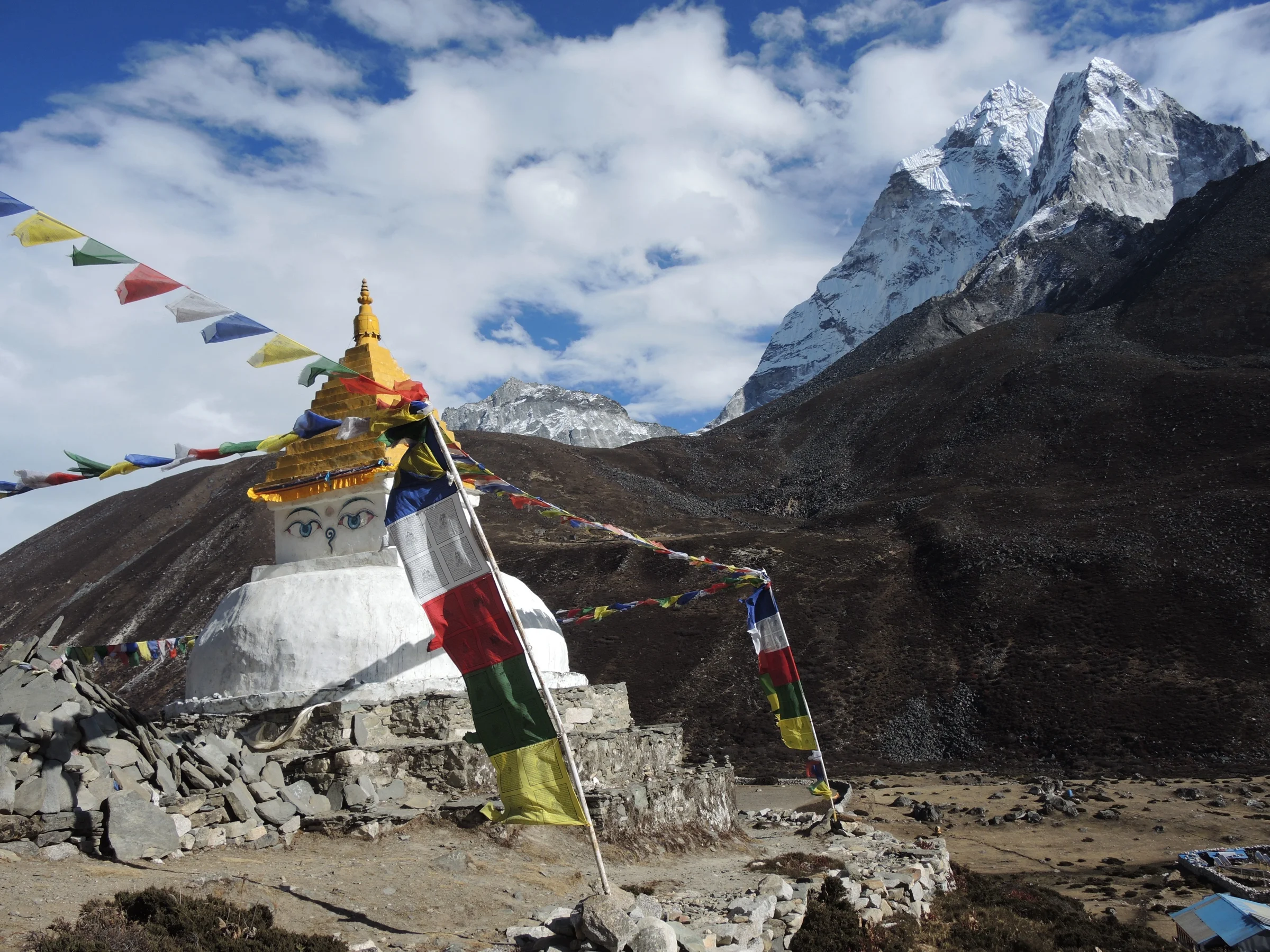
Meet the inhabitants of the Sherpa villages and discover their culture, with visits to the monasteries of Tengboche and Pangboche.
Itinerary
A representative of our local partner welcomes you on your arrival at Tribhuvan International Airport in Kathmandu. After a short car journey, you reach your hotel where you can rest and drop off your belongings. The rest of the day is free to explore the city, and a welcome dinner is offered in the evening. Night in Kathmandu (1,400 m).
The day is devoted to preparations for the climb: an orientation meeting, meeting the guide, checking the technical equipment and, if necessary, renting or buying additional gear. The rest of the time is free to explore the city. Night in Kathmandu (1,400 m).
After a hearty breakfast, you set off for Lukla. The flight to Lukla leaves from either Kathmandu or Ramechhap, depending on availability, which is known at booking. From Ramechhap, allow 4 to 5 hours by road followed by a 15-minute flight; if a flight is available from Kathmandu, it is a direct flight of about thirty minutes. This flight offers superb views of the Khumbu region, and the landing at Lukla, on a short runway, is impressive. Collect your belongings and take the trail that crosses the Himalayan terrain to the village of Phakding. Night in Phakding (2,610 m).
You pass through pine forests and follow the banks of the Dudh Koshi River. The magnificent Mount Thamserku (6,623 m) greets you, and you can glimpse Everest (8,848 m) as well as the Lhotse–Nuptse ridge. You continue to Namche, the largest Sherpa settlement in the Everest region. Night in Namche Bazaar (3,440 m).
This day is devoted to acclimatisation. Make the most of it to explore the surroundings of Namche Bazaar. Hike up to the Everest View Hotel, often considered the highest hotel in the world. You can also walk to the village of Khumjung and visit its monastery. Night in Namche Bazaar (3,440 m).
You first head towards Phunki, then follow the road leading to Tengboche. After visiting the famous Tengboche Monastery, you enter Sagarmatha National Park. You have a spectacular view of Everest (8,848 m), Nuptse (7,861 m), Lhotse (8,516 m), Ama Dablam (6,812 m) and Thamserku (6,623 m). The trail, with little vegetation, gradually turns into a snow-covered path. You reach Tengboche in the late afternoon. Night in Tengboche (3,860 m).
The route to Pheriche offers a magnificent view of the surrounding scenery. You descend through the forests for about an hour, then cross the river. You then make a climb before a short lunch break in the village of Pangboche. From Pangboche, it is only a short walk to Pheriche. Night in Pheriche (4,371 m).
This day is devoted to rest and acclimatisation, at an altitude of more than 4,000 metres. If you wish, you can go to Dingboche to explore the Sherpa camps and the area around the village. A hike up to Nangkartshang (5,083 m) reveals a panorama over Makalu (8,485 m), Lhotse (8,516 m), Lhotse Shar (8,383 m) and Island Peak (6,165 m). After admiring this panorama, you descend back to Pheriche. Night in Pheriche (4,371 m).
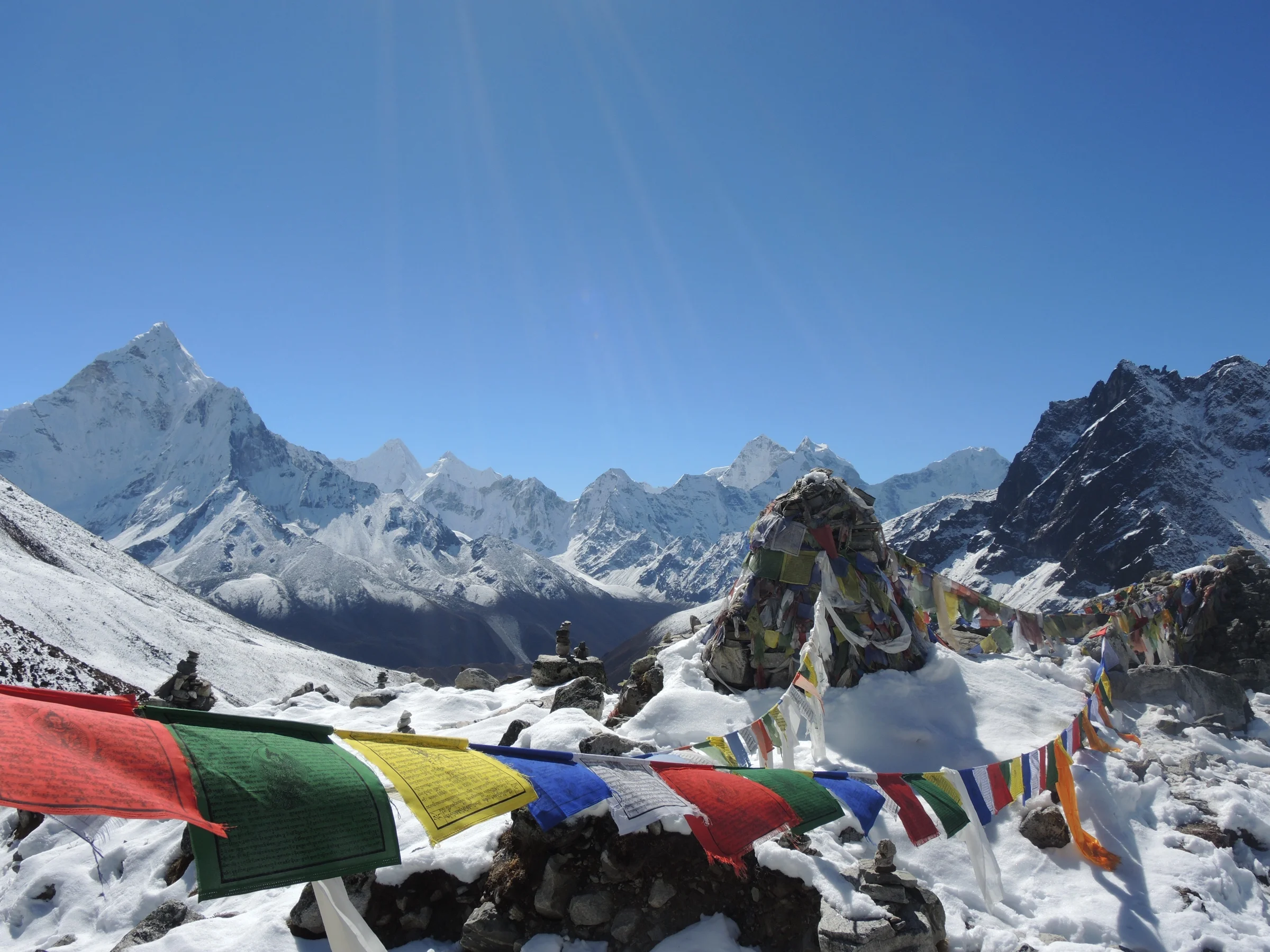
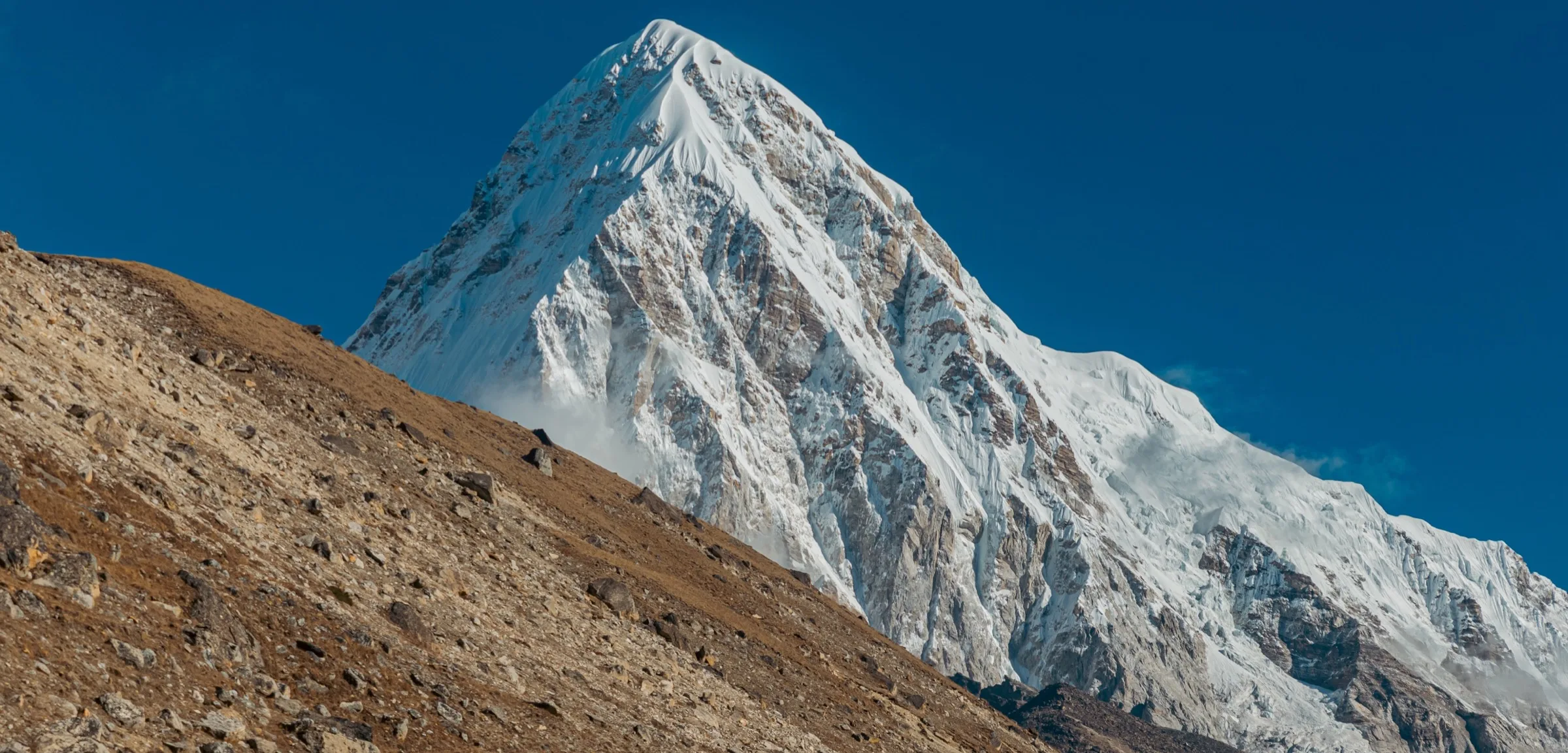
From Pheriche, the route is easy to Dughla. You then climb the steep moraine of the Khumbu Glacier and cross the rocky steps of Chupki Lhara, where there are prayer flags and memorial sites. The trail continues across the moraine of the Khumbu Glacier, from where you can admire the magnificent ranges of Khumbutse, Lingtren, Pumori and Mahalangur Himal ranges. Night in Lobuche (4,910 m).
The route to Everest Base Camp passes by Gorak Shep lake. It alternates between demanding trails and tricky terrain: you cross rocky dunes and watercourses before reaching Everest Base Camp (5,364 m), where colourful tents stand out against the white landscape. After visiting base camp, you return to Gorak Shep. Night in Gorak Shep (5,164 m).
The temperature drops sharply today as you set off on the trek to the Kala Patthar viewpoint. You walk between the Lingtren, Khumbutse and Changtse ranges, and Everest (8,848 m) gradually comes into view. After braving the snow-covered terrain, you reach Kala Patthar, from where you can admire the enchanting charm of the Khumbu region and Everest (8,848 m). From Kala Patthar, you retrace your steps to Lobuche. Night in Lobuche (4,910 m).
You walk along the Khumbu Glacier towards Kongma La base camp. The highlight of the trail is the climb of the Kongma La pass (5,535 m), where prayer flags can be seen at the top. You then descend gradually towards the Imja Khola River valley, and a final descent leads to Chhukung, a small village inhabited by Sherpas. Night in Chhukung (4,730 m).
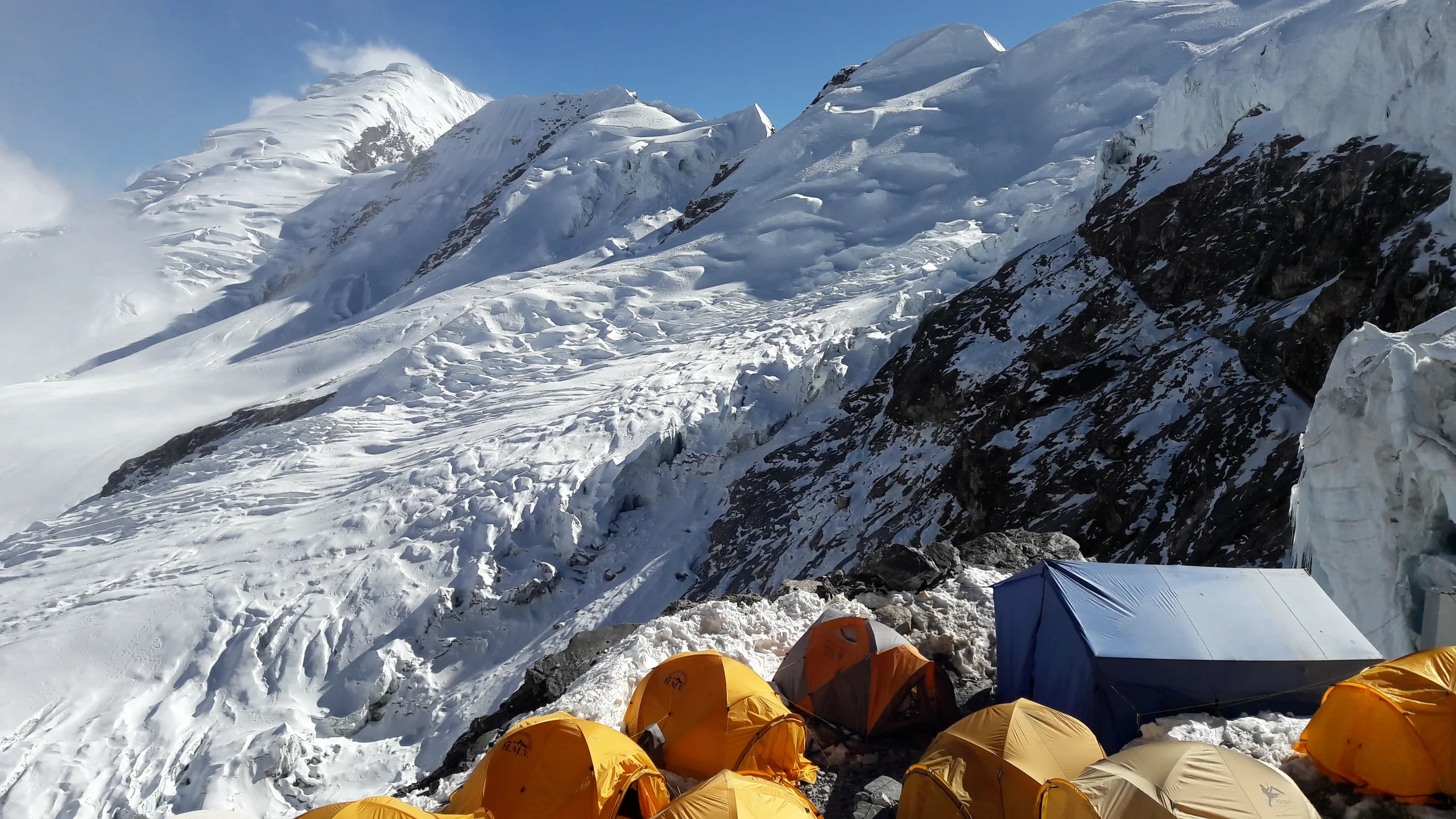
The trail to base camp is fairly steep. You first head south, then east to join the main axis of the valley. The moraine gradually widens and the Lhotse Glacier comes into view. The route to Amphu Lapcha (5,663 m) lies to the south-east. The winding path follows the Imja Khola River and the glacial moraines. You reach Island Peak Base Camp, where the tents are set up.
The afternoon is devoted to a training session: the guides teach you the techniques needed to climb Island Peak, in particular the correct use of the ice axe, mountaineering boots, harness and jumar. A good command of this equipment is key to the safety and pace of the next day's climb. Night at Island Peak Base Camp (5,090 m).
Today is summit day. The wake-up is early and, after a hearty breakfast, you set off onto the snow-covered terrain. Snow and icy winds accompany you all the way. You have to climb steep slopes with equipment such as rope, ice axe and, at times, ladders. After crossing crevasses, you finally reach the summit of Island Peak (6,165 m), from where you can see Everest (8,848 m), Lhotse (8,516 m), Nuptse (7,861 m) and many other peaks. You then descend to base camp, where you spend the rest of the day. Night at Island Peak Base Camp (5,090 m).
A relatively easy trail leads back down to a lower altitude. You walk through the wide Khumbu Khola River valley and pass through a few Sherpa villages. The trail then leads to Pangboche, where you visit the gompa, said to be one of the oldest in the Khumbu region. From Pangboche, superb views open to the east over Ama Dablam (6,812 m), Thamserku (6,623 m) and Kangtega (6,782 m). Night in Pangboche (3,985 m).
The trail crosses the Imja Khola River and enters the forests of Tengboche. After a short visit to Tengboche Monastery, you pass again through rhododendron forests. You follow the Dudh Koshi River and reach Sansa. You may glimpse wildlife there, such as leopards and mountain goats. The army base camp marks the arrival at Namche Bazaar. Night in Namche Bazaar (3,440 m).
Today's trail loses a lot of altitude, so it is best to proceed with care. You cross the tumultuous Dudh Koshi River and its tributaries on tired legs. The trail then becomes more even all the way to Lukla. Night in Lukla (2,860 m).
You board a plane early in the morning from Lukla. Depending on availability, known at booking, the flight from Lukla lands in either Kathmandu or Ramechhap. At Ramechhap, our vehicle is waiting for the 4 to 5-hour road journey to your hotel in Kathmandu. This flight offers a magnificent view of the Khumbu region. Depending on your arrival time, you can take a quick tour of the local markets to buy gifts and souvenirs. In the evening, a farewell dinner celebrates your climb. Night in Kathmandu (1,400 m).
This day is a necessary margin in case of flight delays out of Lukla. Delays are common, and a contingency day is a wise precaution. If you return on the planned schedule, the day is free for sightseeing or shopping on your own. Night in Kathmandu (1,400 m).
As the Island Peak climb with Everest Base Camp comes to an end, you take your international flight home. A representative of our local partner accompanies you on the journey to the airport.
Practical information
Best time to go
The best seasons for this trip are spring (March to May) and autumn (October to December), when the weather is most stable and the mountain views are clear. The trails are busier in these seasons. In winter, the passes may be blocked by ice or snow; during the monsoon and winter the routes are much quieter.
What the price includes
Included
- nights in a 3-star hotel, in a shared room, with breakfast
- nights in a lodge, in shared accommodation
- nights in a tent, in shared accommodation
- a welcome dinner and a farewell dinner
- 3 meals a day during the trek and the climb
- half a litre of water at lunch and dinner during the trek and the climb
- a hot drink on arrival at the day's stage during the trek and the climb
Not included
- lunches and dinners in Kathmandu
- sweets and snacks
- single-room supplements
- drinks other than those listed as included
- showers and hot water during the trek and the climb
- laundry
Included
- airport–hotel transfers for the international flights
- airport–hotel transfers for the domestic flights
- domestic flights
- road transport
Not included
- international flights
- excess baggage fees on domestic flights
- helicopter flights