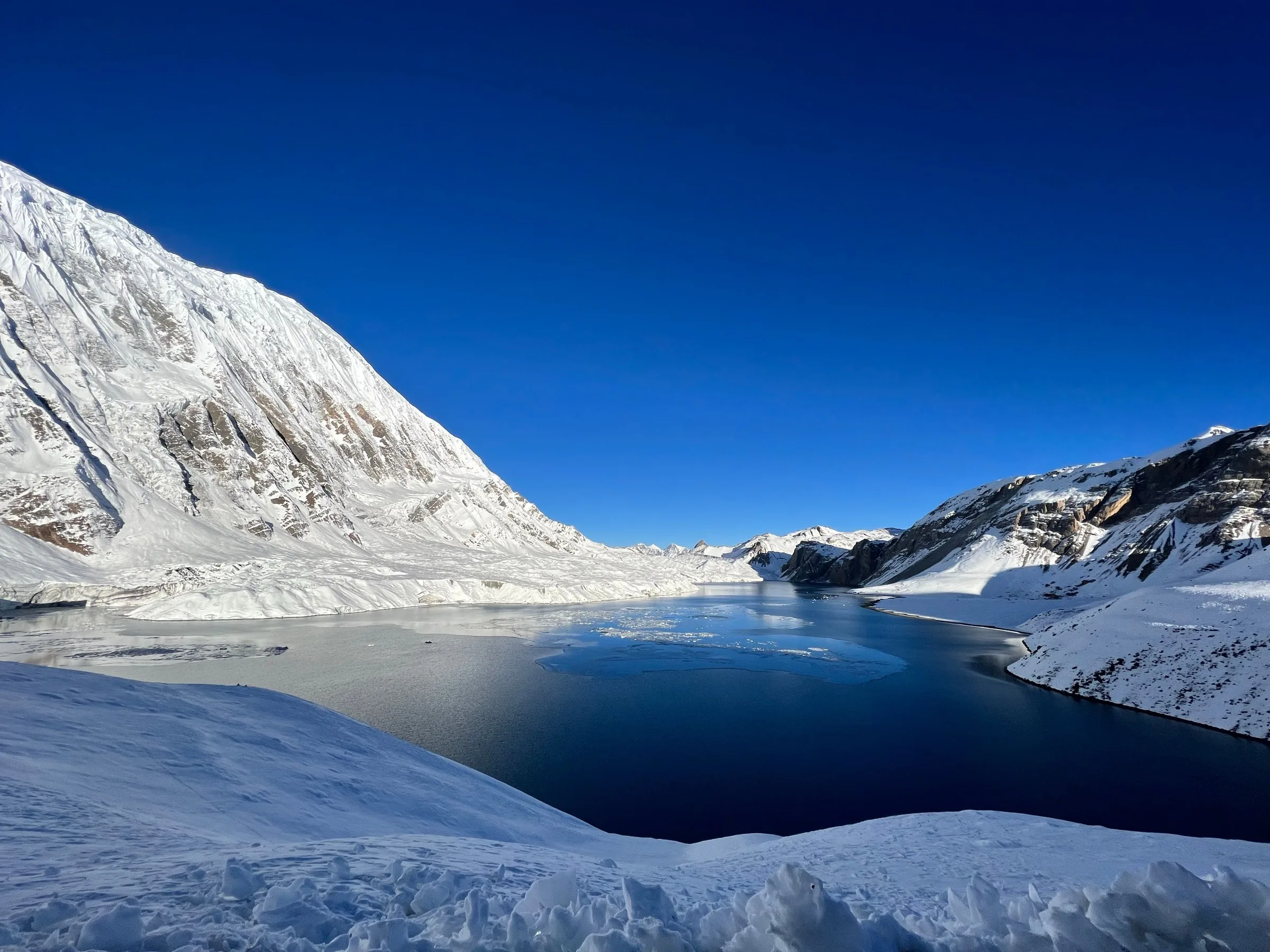
Regarded as one of the longest and most complete treks in the world, the Annapurna Circuit is not only a journey through exceptional natural landscapes: it is a genuine cultural voyage. Over more than 200 km and across four districts of Nepal, the route makes a full circuit of the Annapurna Conservation Area and the massif of the same name. Accessible to trekkers of varying experience, it nonetheless demands good physical preparation, because of its length and the altitude reached at the pass. All along the way, the peaks of Annapurna, Dhaulagiri and Manaslu reveal themselves, alongside Machhapuchhre (6,993 m), Tilicho Peak (7,134 m) and Pisang Peak (6,091 m).
This trek begins in Kathmandu. The road then leads north-west, via Besisahar, as far as Dharapani, from where the trail starts towards the village of Chame. The route progresses anticlockwise, crossing the highland villages of Lower Pisang, Manang and Yak Kharka, before crossing the Thorong La pass (5,416 m) to reach the Mustang district.
Because of its proximity to Tibet, this region has a resolutely Tibetan way of life, culture and traditions. On the far side of the pass, the pilgrimage site of Muktinath, revered each year by thousands of Hindu and Buddhist pilgrims, marks the entry into a semi-arid, desert-like landscape, very different from the green valleys of the start. The descent continues to Jomsom, the windy town of Mustang, from where a trans-Himalayan flight reaches Pokhara. From there, the return to Kathmandu is made by road (or with a short flight possible as an option).
The trek is best undertaken in spring (March–May) or autumn (September–November). In spring, the flowering rhododendron forests and mild temperatures offer pleasant conditions, for beginners and experienced trekkers alike. Autumn, considered the best season overall, follows the monsoon rains: the air is clearer, the views of the peaks sharper, and the trails livelier, carried along by the Nepalese festivals of Dashain and Tihar.
Between Tibetan villages of Mustang, a pilgrimage sanctuary, a high pass and panoramas over three massifs of more than 8,000 metres, the Annapurna Circuit combines a real physical challenge, driven by the length of the route and the altitude of the Thorong La pass, with a cultural diversity that is rare on a single itinerary.
Highlights
The Tibetan villages of Upper Manang
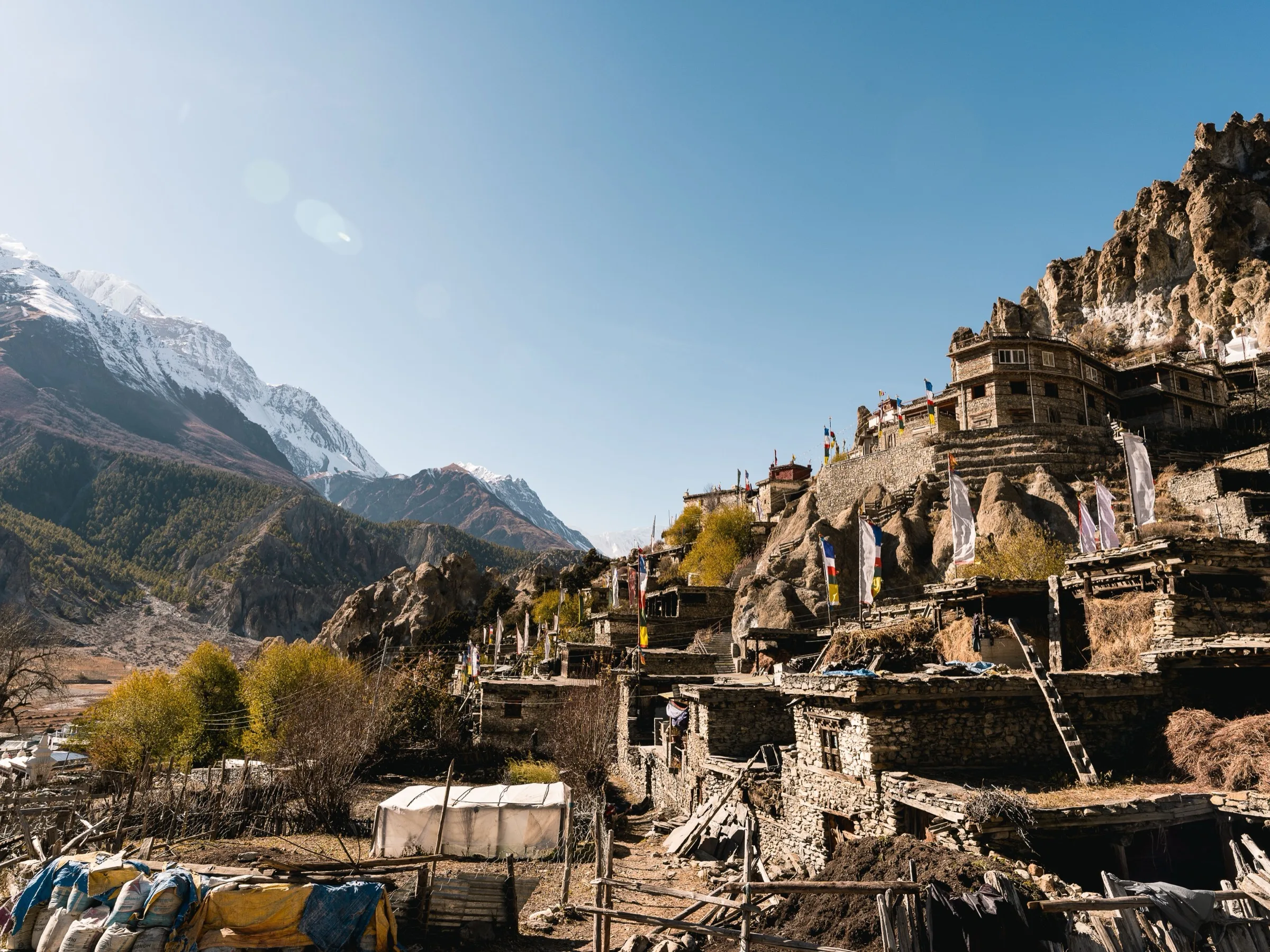
Cross Upper Pisang, Ngawal, Ghyaru and Braga, where the stone architecture and flat roofs bear witness to the closeness of Tibet.
Muktinath Temple
Visit this both Hindu and Buddhist pilgrimage site, surrounded by 108 stone water spouts, a great spiritual landmark of Mustang.
The Thorong La pass
Cross, at 5,416 m, one of the highest and busiest passes in the world, the high point of the trek and the tipping point onto the arid side of Mustang.
The panoramas over Annapurna, Dhaulagiri and Manaslu
Take in these three massifs, along with Machhapuchhre, Tilicho Peak and Pisang Peak, visible throughout the route.
The crossing of Mustang
Discover the semi-arid, desert-like landscapes of this district, a striking contrast with the green valleys of the start.
Itinerary
On your arrival in Kathmandu, a representative of our local partner welcomes you at Tribhuvan International Airport and drives you to your hotel in Kathmandu. After check-in, you meet your trek guide for an initial discussion about how the trip will unfold. A welcome dinner is offered in the evening. Night in Kathmandu (1,400 m).
A safety day before leaving for the Annapurna Circuit: it makes up for a delayed international flight or lets the permits be finalised. If everything is in order, use the morning to check your equipment, then visit Kathmandu in the afternoon — Swayambhunath, perched on its hill, or Durbar Square. Night in Kathmandu (1,400 m).
Today is a long day by road, about 220 km in 8 to 10 hours, which takes you from Kathmandu to the foot of the Annapurna Circuit. You leave in the morning towards north-west Nepal. The road winds over hills and deep gorges, following a powerful river for 172.9 km (about 6 hours) to Besisahar, a small town that marks the gateway to the trail. The journey then continues along the Marsyangdi valley, through terraced hills, forests and Gurung villages, to Dharapani. It is a first taste of the landscapes and villages of mid-western Nepal before the walking begins. Night in Dharapani (1,860 m).
The trek begins. From Dharapani, the trail follows the Marsyangdi River through pine and fir forests, crossing suspension bridges and passing small villages, with views of Lamjung Himal (6,983 m). It leads to Chame, the administrative centre of the Manang district, a village of fewer than 1,500 inhabitants. Night in Chame (2,670 m).
The trail climbs gradually through the forest to the village of Lower Pisang, passing through Telekhu, Bhratang and Dhikur Pokhari. Set in the Marsyangdi valley, south of Pisang Peak, the village offers an open view of the Annapurna massif. Night in Lower Pisang (3,200 m).
This stage leads from Lower Pisang to the village of Manang. The closeness of Tibet, to the north, can be read in the architecture of the villages you pass through — Upper Pisang, Ngawal and Ghyaru — with their stone houses typical of the region. The trail then passes through Humde and Braga before reaching Manang. Night in Manang (3,519 m).
This day is set aside for acclimatisation in Manang, before continuing to higher altitude. A short hike around the village helps prepare the body for the rest of the trek. Manang retains a history linked to yak herding and the salt trade with Tibet, and offers views of Gangapurna (7,455 m), Tilicho Peak (7,134 m), Kang Guru (6,981 m) and Thorong Peak (6,144 m). Night in Manang (3,519 m).
The climb continues from Manang towards the village of Tengi, along the watercourse that leads to the Jharsang Khola River valley, north-west of the Marsyangdi valley. The trail passes through juniper groves, then the Tibetan-influenced village of Ghunsang, recognisable by its flat-roofed mud houses and its yak pastures, before reaching Yak Kharka. Night in Yak Kharka (4,050 m).
The altitude keeps rising towards Thorong Phedi, a tiny hamlet set at the foot of the Thorong La pass (5,416 m). The landscape becomes desolate and treeless, while the trail follows the cold waters of the Marsyangdi. This stage, often snow-covered during the monsoon and winter, is an unavoidable one before crossing the pass the next day. Night in Thorong Phedi (4,540 m).
You set off early to cross the pass in good conditions. The climb, on a trail often covered by a thick layer of snow, leads to the top of the Thorong La pass (5,416 m), the high point of the trek, from where the view extends over the Himalayan peaks on the Tibetan side. The descent, on the far side of the pass, reveals a markedly more arid landscape, characteristic of the Mustang district. The day ends at Muktinath, a pilgrimage site revered by Hindu and Buddhist pilgrims. Night in Muktinath (3,762 m).
The morning is devoted to visiting Muktinath Temple, whose grounds house a small shrine surrounded by 108 stone water spouts. The trail then reaches Jomsom via the village of Kagbeni, through the Kali Gandaki valley. Arriving in Jomsom in the late morning is a chance to discover the local apple brandy, Marpha, and Thakali cuisine. Night in Jomsom (2,743 m).
An early flight links Jomsom to Pokhara, flying over the Annapurna massif and the dense forests of the conservation area below. The afternoon is devoted to exploring Pokhara, a tourist town renowned for activities such as paragliding, bungee jumping, ziplining and boat trips, and for sites such as Davis Falls, Mahendra Cave, the Peace Pagoda and Phewa Lake. Night in Pokhara (822 m).
You return to Kathmandu by road, a journey of about 200 km and 6 to 7 hours through the hills, following the Trishuli River past terraced slopes and traditional villages. In the evening, a farewell dinner celebrates the successful completion of your Annapurna Circuit. Night in Kathmandu (1,400 m).
A representative of our local partner drives you to the airport in a private vehicle, about 3 hours before the scheduled time of your international flight.
Practical information
Best time to go
The best seasons for the Annapurna Circuit are spring (March to May) and autumn (September to November). Both offer clear mountain views, stable weather and pleasant temperatures.
In spring, the rhododendron forests and wildflowers are in bloom and the days are mild, which suits beginners and experienced trekkers alike. Autumn, just after the monsoon, is considered the best season overall: the air is fresh and clear, the weather stable, and the trails lively, with the Dashain and Tihar festivals adding a cultural touch.
The trek can also be done in winter or during the monsoon, when the trails are much quieter, but snow or ice may block the Thorong La pass.
What the price includes
Included
- nights in a 3-star hotel, in a shared room, with breakfast
- nights in a lodge, in shared accommodation
- a welcome dinner and a farewell dinner
- 3 meals a day during the trek and the climb
- half a litre of water at lunch and dinner during the trek and the climb
- a hot drink on arrival at the day's stage during the trek and the climb
Not included
- lunches and dinners in Kathmandu
- sweets and snacks
- single-room supplements
- drinks other than those listed as included
- showers and hot water during the trek and the climb
- laundry
Included
- airport–hotel transfers for the international flights
- airport–hotel transfers for the domestic flights
- domestic flights
- road transport
Not included
- international flights
- excess baggage fees on domestic flights
- helicopter flights