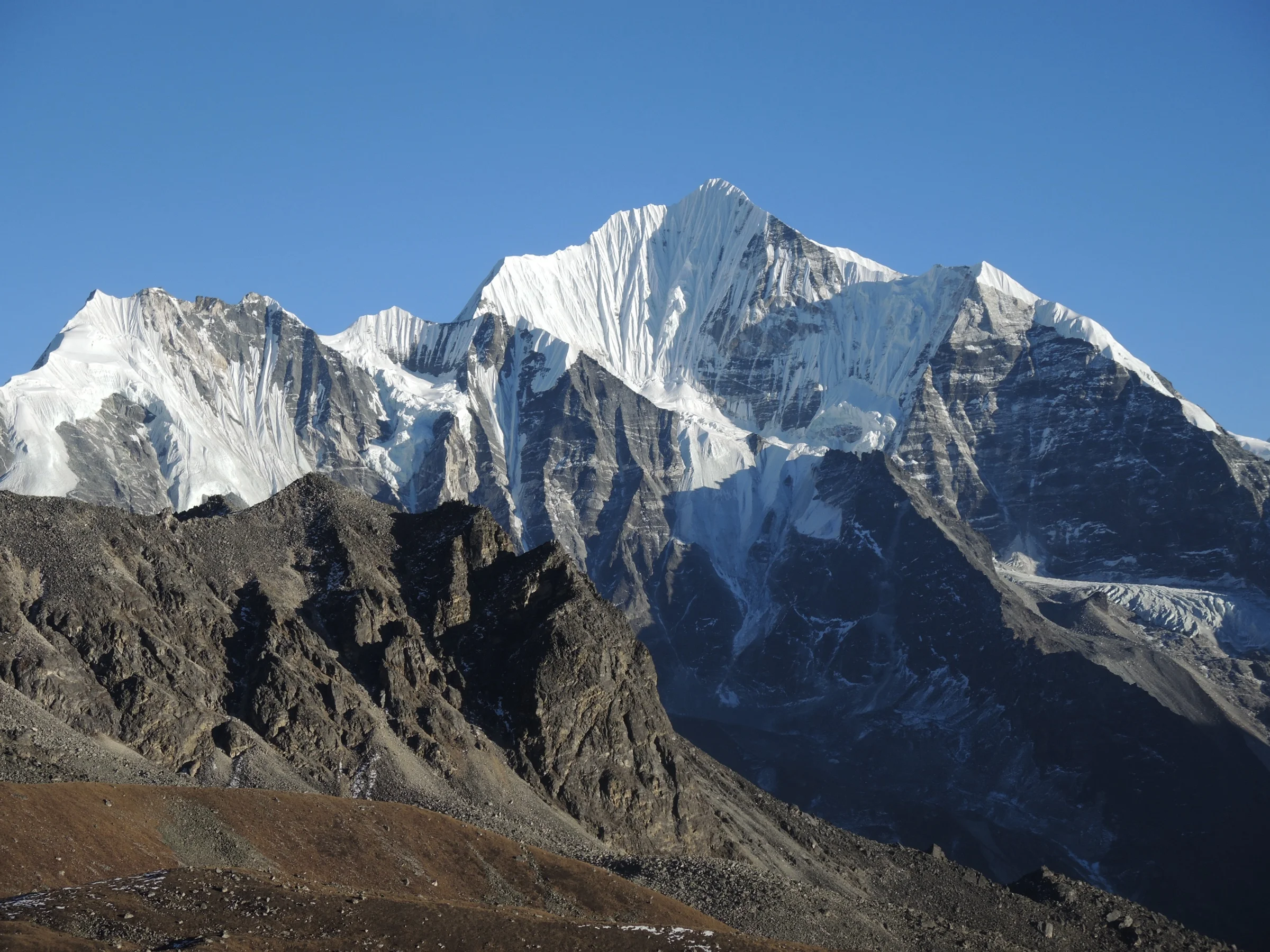
Himlung Himal (7,126 m) rises in the Peri-Damodar range, in north-west Nepal, in the immediate vicinity of the Tibetan border, in the Annapurna region. The range is renowned for its spectacular peaks and demanding climbs; besides Himlung, it includes Chulu East, Chulu West and the Damodar Himal. This closeness to Tibet imbues the whole region with a resolutely Tibetan culture, language and architecture.
Isolated, the region can only be approached at the end of a long trek to base camp. Away from the main trekking circuits, the caravan follows high passes, remote villages, narrow ravines, forests and rock walls, passing springs, gompas and hamlets with a distinctive culture.
This 7,000-metre summit attracts climbers in search of new horizons. Without the technical difficulties typical of other peaks in this category, Himlung Himal is often chosen as a preparatory climb for a first 8,000er. It remains, nonetheless, one of the technically most accessible Himalayan 7,000ers, and one of the most rewarding. From base camp (4,900 m), the climb is organised in the classic way, with three high camps, linked by sections of snow and ice fitted with fixed ropes, up to the summit.
The expedition begins with a drive from Kathmandu to Koto, via Besisahar, followed by an approach on foot through the Nar Phu valley, a restricted area, via Meta, Kyang and Phu Gaon, to base camp. The climbing window leaves room for the acclimatisation rotations between the camps and for the weather; the return follows the same trail to Koto, then the road to Kathmandu. Spring (April to May) and autumn (October to November) are the best seasons, autumn generally offering the more favourable conditions.
Safety at high altitude remains the constant priority of our local partner's team: rigorous planning and a step-by-step progression accompany each member of the expedition, in a setting that is both demanding and unspoilt, far from the crowds of the great 8,000ers.
Highlights
The Nar Phu
A valley away from the classic circuits. This restricted area of Nepal, on the edge of Tibet, can only be crossed with a special permit and keeps a strongly Tibetan character.
Himlung Base Camp
Nestled at the foot of the south-west face at 4,900 m, surrounded by glaciers and peaks, it is the starting point for the climbing period.
The ascent of Himlung Himal
This 7,126 m peak in the Peri-Damodar range is among the technically most accessible Himalayan 7,000ers, often chosen as a preparatory climb for a first 8,000er.
Unspoilt wildlife and flora
Forests of pine, oak and rhododendron line the caravan, home to Himalayan black bear, musk deer, Himalayan tahr, snow leopard, alpine ravens and choughs.
The Yarsagumba
This rare Himalayan medicinal plant, protected and renowned for its properties, grows in high concentration around Himlung Himal, right up to base camp.
An unspoilt Tibetan cultural heritage
Ancient hamlets, centuries-old gompas and chortens (Buddhist monuments), a transhumance economy and agro-pastoralism set the rhythm of the crossing of the Nar and Phu valleys.
Itinerary
Welcome to Nepal. On arrival at Tribhuvan International Airport, a representative of our local partner welcomes you and takes you to your hotel in Kathmandu. The rest of the day is free, and a welcome dinner is offered in the evening. Night in Kathmandu (1,400 m).
These two days are devoted to the last preparations for the climb: administrative formalities, a full equipment check and a briefing with the technical team on the use of mountaineering gear. Depending on the time available, you can also explore some of the UNESCO World Heritage Sites in the Kathmandu valley — Pashupatinath, Boudhanath, Swayambhunath and Durbar Square are among the main places to visit. Nights in Kathmandu (1,400 m).
A first day on the road takes you from Kathmandu to Besisahar. The Prithvi Highway winds west following the course of the Trishuli River, through the small towns of Malekhu and Mugling. The landscape gradually changes, between natural and cultural diversity. Night in Besisahar (760 m).
The road continues today from Besisahar to Koto, for another long day. After breakfast, it passes through Syange and then Dharapani, against a backdrop of snow-capped peaks, waterfalls and green hills, to Baharchhap. From there, the rough tracks of the Annapurna Circuit lead to the village of Koto. Night in Koto (2,600 m).
This day marks the entry into the restricted area of the Nar Phu valley, after presenting the permits at the police checkpoint. The trail leads to Meta, following the Soti Khola River through pine and rhododendron forests, past waterfalls. From the hamlet of Dharamsala, the trail becomes steep, climbing in narrow switchbacks up sloping hillsides to the village. Night in Meta (3,560 m).
From Meta, the trail leads to Kyang, with Pisang Peak (6,091 m) as a backdrop. It passes through Jhunum and then the village of Chyakhu, where two rivers are crossed, including the Murju Khola River, before crossing long stony stretches dotted with chortens to the hamlet of Kyang. Night in Kyang (3,840 m).
After Kyang, and the crossing of the Phu Khola River, the trail enters a vast blue-pine forest, watched over by Annapurna I (8,091 m) and Annapurna IV (7,525 m). A few monasteries line the climb to Phu Gaon, a small medieval village with a distinctive culture and traditions, where Himlung Himal appears for the first time in the distance. Night in Phu Gaon (3,900 m).
The trail leads from Phu Gaon to Himlung Base Camp, through yak pastures, snow-covered terraces and long glaciers. The trail leaves aside the branch to Ratna Chuli, then climbs steeply to the top of a ridge before reaching the camp, where the tents are set up for the climbing period. Night at Himlung Base Camp (4,900 m).
These days make up the climbing window itself. After a day of rest and technical preparation at base camp, the climb begins towards Camp I, crampons and ice axe in hand, across snow-covered terraces and glaciers, watched over by high snow-capped mountains. The climb from Camp I to Camp II is steep and made on a fixed rope; on arrival, the view opens onto the Annapurna massif and Dhaulagiri (8,167 m). Camp III is then reached by traversing snow slopes, a stage that may require several attempts depending on conditions. It is from there that the final climb to the summit of Himlung (7,126 m) sets off, at the end of which a panorama opens onto a multitude of snow-capped peaks. The descent is made by the same route to base camp. Nights in a tented camp.
The return begins with the walk from base camp to Phu Gaon, on the same trails as the outward journey: yak pastures, forest, sharp slopes and high hills. The views of Annapurna I (8,091 m), Annapurna IV (7,525 m) and Dhaulagiri (8,167 m) accompany the descent. Night in Phu Gaon (3,900 m).
Watched over by Himlung Himal (7,126 m), the trail descends to Meta, crossing the Phu Khola River, then long stretches dotted with chortens. After the hamlet of Chyakhu and the Murju Khola River, the view opens onto Annapurna II (7,937 m), Pisang Peak (6,091 m) and Lamjung Himal (6,983 m). Night in Meta (3,560 m).
After breakfast, the trail leaves Meta to reach Koto. It descends through the rhododendron and pine forest, with its wildlife and lush vegetation, to the hamlet of Dharamsala, then follows the Soti Khola River, crossing many waterfalls and suspension bridges, largely following the course of the Nar Khola River. Night in Koto (2,600 m).
Today is a day on the road: the way back from Koto to Besisahar goes down the Marsyangdi valley. Near Baharchhap, the distinctive traditions of the Sherpa and Gurung peoples are revealed, and the road passes through the village of Dharapani, still offering a few glimpses of the snow-capped peaks. Night in Besisahar (760 m).
Today, you say your goodbyes to the Himalayas. The road takes you back from Besisahar to Kathmandu, via the towns of Mugling and Malekhu, along the Trishuli River. The last panoramas of the mountains and hills accompany the journey before arriving in the capital, where the end of the day can be spent on last-minute shopping. A farewell dinner in the evening brings the expedition to a close. Night in Kathmandu (1,400 m).
Last day in Nepal. A representative of our local partner accompanies you to Tribhuvan International Airport two hours before the scheduled time of your flight — a chance to share your impressions of this expedition. Goodbye!
Practical information
Best time to go
The best seasons for Himlung Himal are spring (April to May) and autumn (October to November). Autumn generally offers the more favourable conditions for a high-altitude expedition, while spring is the other popular climbing season in Nepal.
What the price includes
Included
- nights in a 3-star hotel, in a shared room, with breakfast
- nights in a lodge, in shared accommodation
- nights in a tent, in shared accommodation
- a welcome dinner and a farewell dinner
- 3 meals a day during the trek and the climb
- half a litre of water at lunch and dinner during the trek and the climb
- a hot drink on arrival at the day's stage during the trek and the climb
Not included
- lunches and dinners in Kathmandu
- sweets and snacks
- single-room supplements
- drinks other than those listed as included
- showers and hot water during the trek and the climb
- laundry
Included
- airport–hotel transfers for the international flights
- road transport
Not included
- international flights
- helicopter flights